Using the term God inevitably imposes a definition, or at least a conceptual frame, on what many traditions claim is ultimately beyond definition. The moment we name something, we delimit it—we make it a thing among other things. But the divine, in many theological and philosophical systems (especially apophatic traditions like negative theology, certain strands of mysticism, and some forms of Eastern thought), is precisely not a thing, not a being, but Being itself, or even beyond being.

Here’s the tension:

 Naming as Necessity: Language allows us to speak about the divine, to share experiences, to form community, ritual, and theology. The term “God” becomes a symbol, a shorthand for the infinite, the mysterious, the source, the good, the one, the creator, etc.
 Naming as Limitation: But every name, even "God," carries cultural baggage, history, gendered connotations, and theological assumptions. To say “God is love” or “God is king” frames the divine in human terms, which might illuminate some truth—but obscures others.

The word God inevitably creates a kind of definition, or at least a conceptual boundary, around something that by nature defies boundaries.

 As some traditions put it:

 Taoism: “The Tao that can be named is not the eternal Tao.”
 Christian Mysticism (e.g., Dionysius the Areopagite): God is best approached by unknowing—a “cloud of unknowing.”
 Judaism: The divine name is considered unpronounceable—YHWH—a reminder of the ineffable.
 Islam: While Allah has 99 names, each expresses an aspect, not a totality. The essence of Allah remains beyond human comprehension.

 Philosophical Note:

 In Wittgensteinian terms, "Whereof one cannot speak, thereof one must be silent." But humans rarely remain silent—we gesture, metaphorize, ritualize.
 In poststructuralist terms, the term God becomes a signifier pointing to an endlessly deferred, elusive signified.

So: the term God is both a bridge and a boundary. It gestures toward the infinite, but it also risks shrinking it to something we can domesticate.
God
June 20th, 1925Ophelia (to the tune of “Oh! Susanna”)
April 2nd, 1925
I.
You wove a crown of meadow blooms,
 With violets in your hair,
 Your fingers traced the rosemary,
 As if it was a prayer.

(Chorus)
 Sweet Ophelia,
 Your flowers fade too fast,
 The river waits, the willow weeps,
 And calls you home at last.

II.
You held a daisy to your lips,
 Then let it float away,
 A rue for all the tears you wept,
 With nothing more to say.

(Chorus)
 Soft Ophelia,
 Your flowers fade too fast,
 The river waits, the willow weeps,
 And calls you home at last.

III.
You reached for something in the dusk,
 The sky was pale and wide,
 You closed your eyes and felt the wind
 Embrace you like the tide.

(Final Chorus - Softly)
 Sing Ophelia,
 Your petals drift and part,
 The water holds you, cool and deep,
 And stills your precious heart.
The Jest of It
March 30th, 1925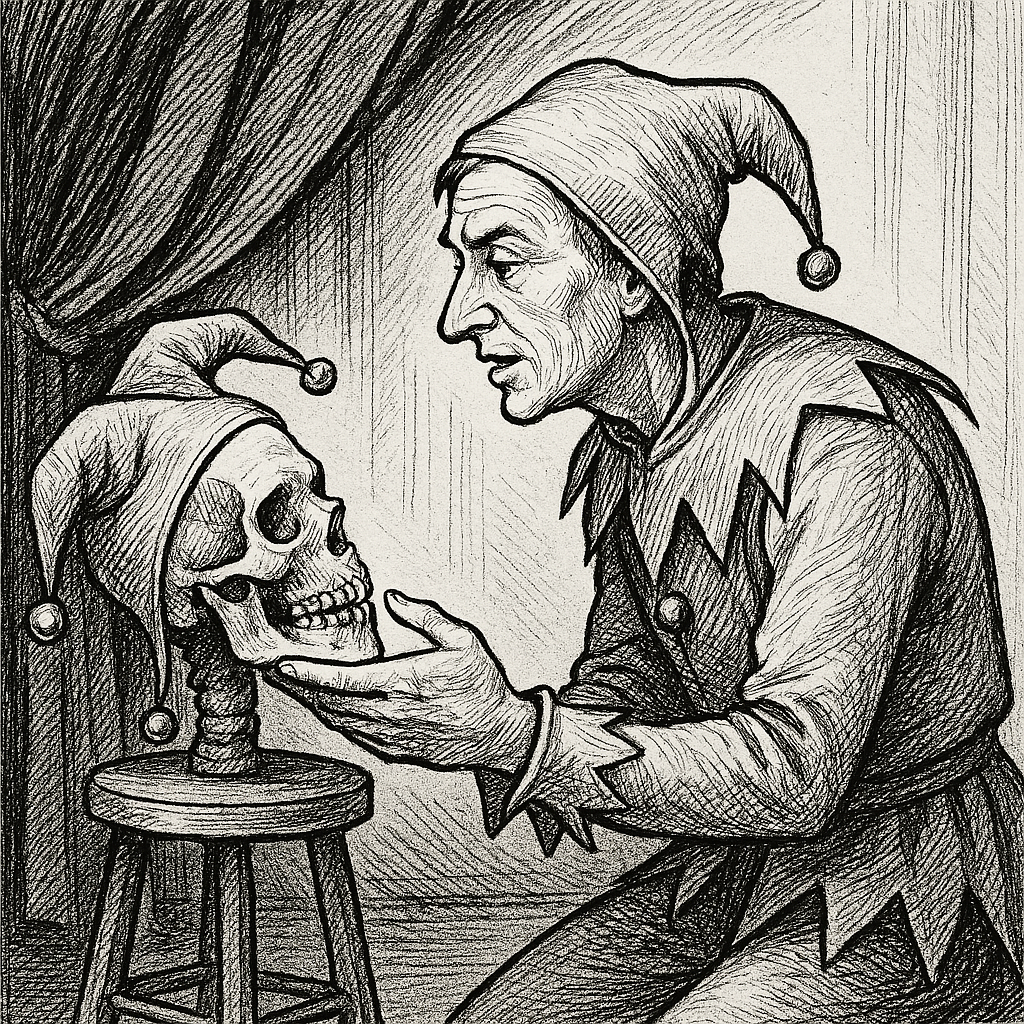
Characters:
- Yorick (Living) – A jester, lively yet reflective.
- Yorick’s Skull (Dead) – A remnant of the past, speaking only through the living Yorick’s imagination.

Setting:
A dimly lit stage. A stool at center, upon which rests an old skull. A fool’s cap drapes over it, its bells still. Yorick, dressed in motley, enters, holding a torch.

---

Scene

(Yorick circles the stool, eyeing the skull with the curiosity of one greeting an old friend. He crouches, peers into its hollow sockets, then straightens, arms akimbo.)

YORICK (Living):
So there you sit, old bone of mine—
What’s left of all my jests and japes.
I wore your face; I filled your flesh,
And now you grin, unburdened, bare.

(He taps the skull gently.)

YORICK (Living):
Did you laugh last, I wonder?
Or was the joke on us?

(A beat, as if waiting for the skull to reply.)

YORICK (as Skull, mimicking a hollow voice):
The joke, dear fool, was always thus:
You lived it, yet you never knew
If jest was mask, or mask was you.

YORICK (Living):
Ah! But a jest is light, a fleeting thing—
A candle's flicker, a feather’s flight!

YORICK (as Skull):
A candle burns, a feather falls.
What’s light is lost. What’s lost is all.

YORICK (Living) (laughing nervously):
Too grim! Too grave!
A jester’s jest is meant to save,
To lift, to lilt, to mock, to tease!

(He spins on his heel, arms wide, inviting laughter from an absent court.)

YORICK (as Skull):
And who, dear fool, did you ever save?

(Yorick halts, the question hanging.)

YORICK (Living) (quietly):
A prince… once.
A child who feared the dark.
A widow who forgot her grief.

(He touches the skull, as if testing its weight in his hand.)

YORICK (as Skull):
And did they stay saved?
Did laughter last?

YORICK (Living) (softly smiling):
No jest lasts forever. But neither does sorrow.

YORICK (as Skull):
Then where lies the jest?

YORICK (Living) (thoughtfully):
Everywhere. In the falling and the flying,
In the candle that burns and the night that follows.
We jest because we die.
We die—but still, we jest.

(He places the skull back on the stool, adjusting the fool’s cap atop it.)

YORICK (Living) (grinning):
The punchline, old friend, is always the same—
Yet still, we laugh.

(He bows, as if concluding a performance. A silence follows. Then—)

YORICK (as Skull, after a pause):
Or perhaps… the jest is that we laugh at all.

(Yorick’s smile fades—not in sorrow, but in wonder. He lets out a small chuckle, then a bigger one, until he’s laughing—not in joy, not in despair, but simply because it is the only thing left to do. The skull sits in silence, grinning its eternal grin. A single bell on the fool’s cap gives a faint chime as the lights fade.)

Blackout.
The Dithering Man and the Deathless Fool
March 30th, 1925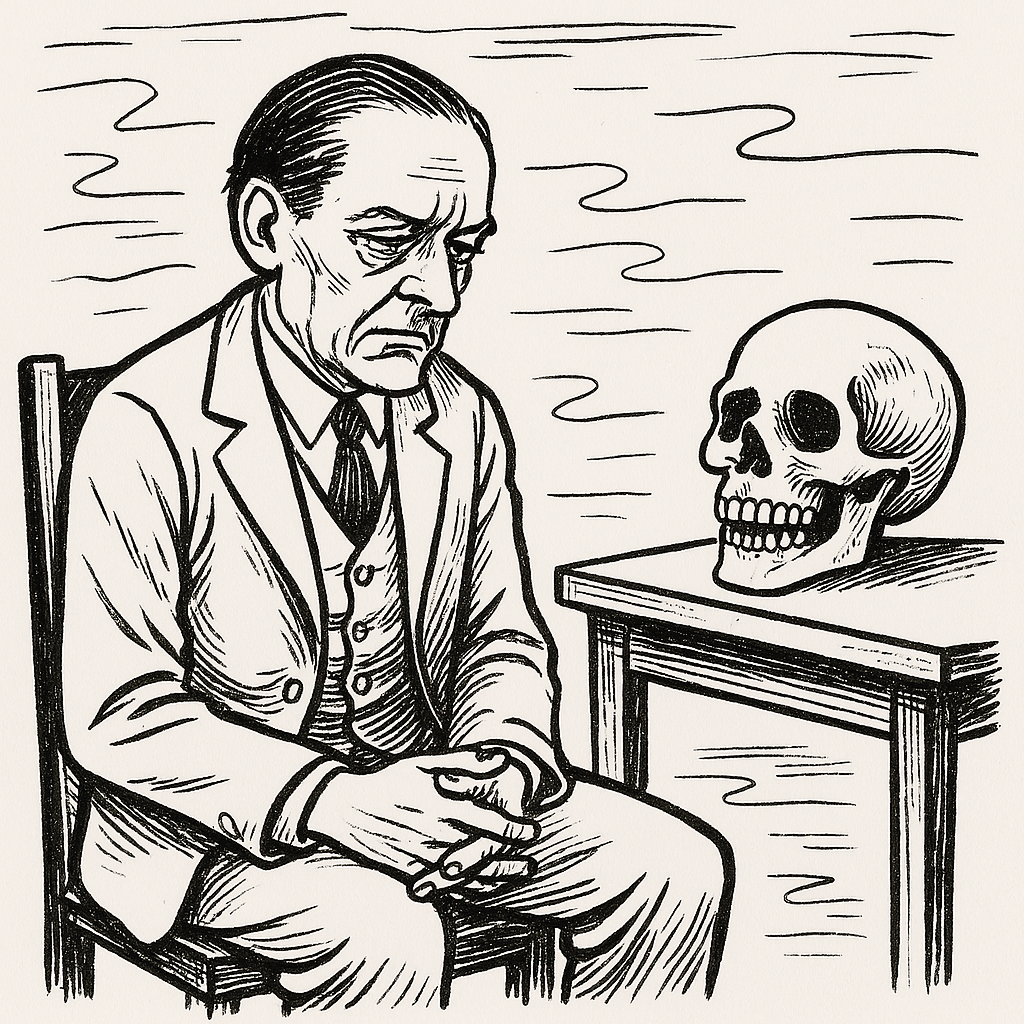
The Dithering Man and the Deathless Fool

A One-Act Play

(A dimly lit room, sparse and unremarkable. A single chair, a table, and atop the table, a grinning skull. PRUFROCK sits stiffly in the chair, hands clasped, gaze distant. YORICK, ever mirthful, lounges atop the table, his voice carrying the weightless ease of someone long past the burden of choice.)

---

YORICK (brightly)
Well met, sir! You sit as though awaiting a verdict. Shall we dare disturb the universe?

PRUFROCK (without turning, voice flat)
And you—are you my judge?

YORICK (laughing)
Me? A judge? No, sir, merely a fool, and fools do not judge. We mock, we prod, we dance along the edge of consequence, but we do not judge. That is left to sterner men.

PRUFROCK (scoffing, shifting in his seat)
And what would you call this? You, rattling in your grave, japing at a man who has yet to step into his?

YORICK (grinning wider, if such a thing were possible)
Ah, but you say “yet” as if time has not already laid his claim. You sit, you measure, you hesitate. You are a man who has buried himself standing.

PRUFROCK (dryly, adjusting his cuff)
I am J. Alfred Prufrock. A man of measured steps, polite smiles, and well-timed coughs. I have walked the dim-lit streets, whispered cautious words at cautious parties, and seen my own life dissected by idle voices.

YORICK (mocking, tilting his head)
A man of half-spoken thoughts and quarter-lived moments! A man who watches the tide roll in and calls it fate.

PRUFROCK (with quiet disdain)
They will say: “His hair is thinning.” They will say: “His arms and legs are thin.”

YORICK (chuckling, shaking his head)
And yet, no one looks upon me and says, “What a well-shaped skull!” The world prattles, my friend, but dust is deaf.

PRUFROCK (leaning forward slightly, eyes narrowing)
And what would you have me do? Swagger like a prince? Spit riddles like a jester? No. I am no Hamlet, nor do I wish to be.

YORICK (mock gasping, hand to his nonexistent heart)
No Hamlet! No great soliloquy! Well then, Polonius perhaps? Fussy, full of proverbs, dying behind the curtain of his own caution?

PRUFROCK (sharp, with an edge he rarely allows himself)
And what of you? A fool who thought himself beloved, only to be tossed into a grave without so much as a sigh. You were passed from hand to hand, and the prince who once clambered upon your shoulders held you aloft only to muse upon his own mortality. You—who made kings laugh—became nothing more than a memento mori.

YORICK (laughing, unbothered, almost delighted)
Oh, and what a fine thing to be! At least I was held. At least I was seen! What are you, Prufrock, but a whisper in the corner of a room where no one listens?

(A silence. PRUFROCK exhales, sinking back into his chair. The sound of distant waves, curling and retreating.)

PRUFROCK (softly, almost to himself)
I have heard the mermaids singing, each to each.
I do not think that they will sing to me.

YORICK (leaning in, voice honeyed with mischief)
Then why not sing first? Roll your trousers, eat the peach, steal a kiss—
or do you mean to drown without a sound?

PRUFROCK (a bitter chuckle, shaking his head)
What foolishness. I am no poet. I am no prince. I am a man who hesitated—

YORICK (grinning, triumphant)
And there’s the tragedy.

(A pause. The waves swell, louder now. The room seems smaller, the chair heavier.)

PRUFROCK (almost a whisper)
Till human voices wake us…

YORICK (softly, as if it were the punchline to the grandest joke of all time)
And we drown.

(Lights fade. The waves linger for a moment longer, then silence.)
The Parable of the Farmer and the Mechanical Rooster
March 21st, 1925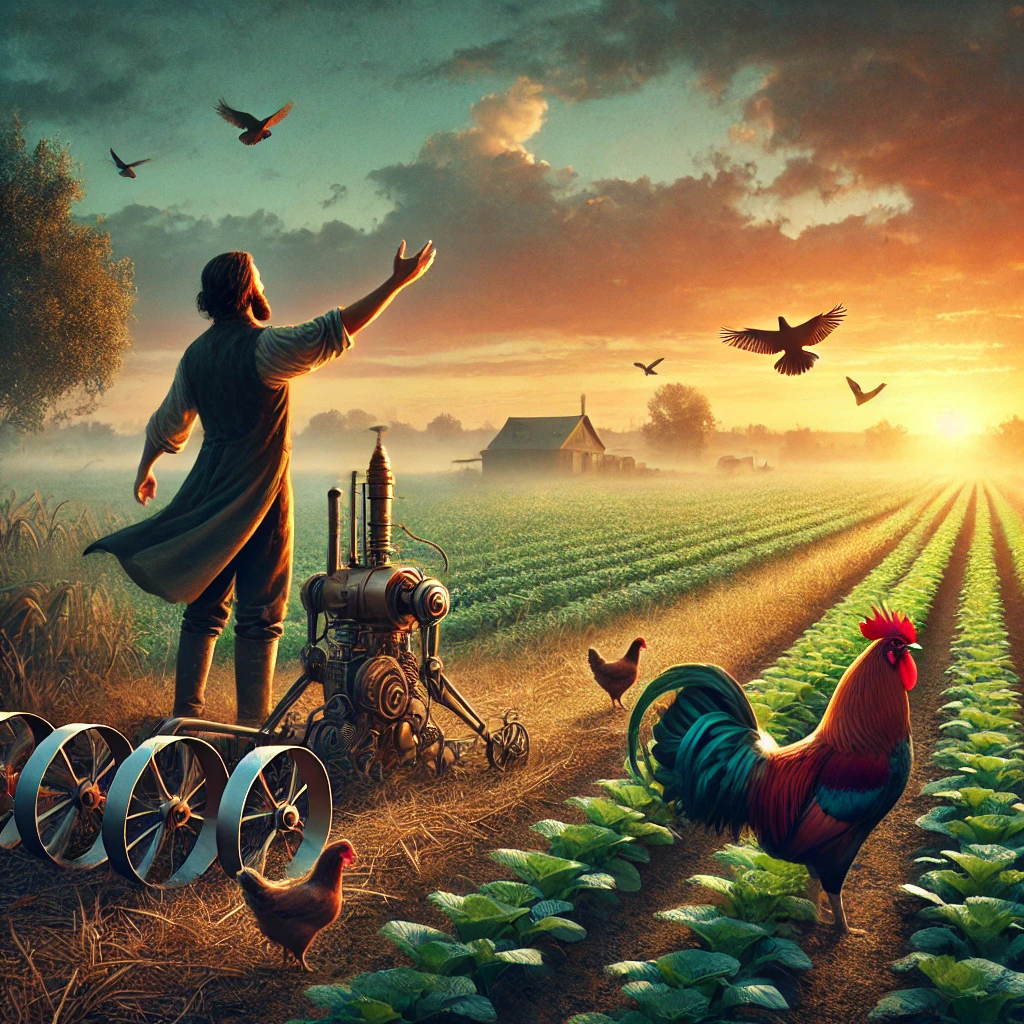
Once there was a farmer who lived at the edge of a quiet village. Every morning, he woke with the dawn to tend to his fields, his chickens, and his crops. His most faithful companion was his rooster, who crowed at the first light, signaling the start of the day.
One year, a traveler came to the village, bringing with him a wondrous invention—a mechanical rooster that crowed precisely at sunrise. Intrigued by this new contraption, the farmer bought it, thinking it would save him from waking early and make his mornings easier.
The first morning after the farmer set up the mechanical rooster, it crowed exactly at dawn, just as promised. The farmer smiled and went back to sleep, confident that his days of waking up early were over.
But as days turned into weeks, the farmer noticed something strange. The fields were no longer as vibrant. The crops didn’t grow as quickly, and the chickens were more sluggish than before. The farmer spent his days tending to the mechanical rooster, making sure it stayed in perfect working order, but he forgot to pay attention to the land, the animals, and his own rhythms.
One day, a neighbor came by and asked, “Why do you rely on that machine so much? The old rooster crowed because he was connected to the earth. You used to know when the day began because you felt it.”
The farmer was puzzled, “But the mechanical rooster is flawless. It’s never late. It never tires. Isn’t that what I want?”
The neighbor nodded slowly, “It’s true that the machine does its job well, but it takes away something essential—the connection between you, the earth, and the world around you. The rooster wasn’t just a signal; it was part of your life. When you relied only on the machine, you forgot to listen to the winds, feel the sun, and hear the quiet wisdom of nature.”
The farmer thought deeply, and the next morning, he rose early, just as he had before. He heard the birds chirping, felt the cool air, and saw the first light creeping over the horizon. And in that moment, he understood. The mechanical rooster had done its job, but it had also detached him from the pulse of his own life. He put it away and returned to the simple, imperfect but real connection he had with the world around him.
From that day on, the farmer woke with the dawn, tended to his fields, and listened to the sounds of the earth. His crops flourished, and his chickens, though imperfect, were healthier. And most importantly, he remembered that while machines could assist, they should never replace the wisdom of one's own senses and instincts.
Moral of the Story: Reliance on technology can bring convenience, but it should never replace the connection to our own experience, intuition, and the world around us.
The Gospel of the Holy Burrito
March 19th, 1925
And lo, the people gathered 'round the Teacher, for they were hungry and weary, having journeyed far to hear His words.

1 And Jesus lifted His eyes upon the multitude, and He saw that they hungered, and He had compassion on them.

2 Then spake He unto His disciples, saying, “What food have ye to give them?”

3 And Andrew answered, “Lord, there is but a single burrito, filled with beans and salsa, and a dollop of sour cream. But what is this among so many?”

4 And Jesus took the burrito, and He lifted it up, and He blessed it, saying, “Father, thou who bringeth forth the harvest and filleth the hungry with good things, bless this burrito, that it may be more than enough.”

5 Then He brake it, and gave to His disciples, and as they passed it out, lo, the burritos multiplied, warm and filled with abundance.

6 And the people ate, and were satisfied, and there was rejoicing, for none were left empty.

7 And when they gathered the fragments, twelve baskets were filled, for the Lord’s provision overfloweth, even in flour and bean.

8 And the people marveled, saying, “Truly, this is the food of heaven, wrapped in goodness and grace.”

Thus was fulfilled what was spoken: “Man shall not live by bread alone, but by every burrito that proceedeth from the hand of the Lord.”

Amen.
Gigantalargo’s Big Problem
March 14th, 1925
Gigantalargo was no ordinary caterpillar. While most of his kind were plump and fuzzy, he was enormous—so large, in fact, that the leaves he munched on trembled under his weight. He was round and jolly, but his size was a bit of a problem.
One day, he felt a deep, instinctual urge: it was time to transform. So, he wobbled his way up a sturdy branch, picked a nice spot, and began to spin his cocoon. The silk wrapped around him in layers, tighter and tighter, until—CRACK! The branch snapped clean off, and Gigantalargo plummeted to the ground.
“Oops,” he mumbled, sprawled on a bed of crushed leaves.
Determined, he tried again, this time choosing the thickest branch he could find. He spun, he wove, he secured himself—and then, just as he felt safe, his heavy chrysalis gave way. POP! The silk ripped, and he tumbled down like a tiny green meteor, landing with a thud.
As he lay there, dazed, a bee buzzed down and hovered above him.
“Whoa,” the bee said. “That was quite the fall.”
“Yeah,” Gigantalargo groaned. “I don’t think this transformation thing is working out.”
The bee scratched his fuzzy head. “I hate to be the bearer of bad news, but, uh… even if you did make it into a butterfly, wouldn’t you be kinda… heavy? Flying might not be your thing.”
Gigantalargo’s tiny heart sank. “You mean… I wouldn’t be able to flutter gracefully through the sky?”
“More like… you’d flutter straight down,” the bee admitted. “But hey, not all bugs have to fly! You’ve got something special going on here.”
“Like what?” Gigantalargo sniffled.
“Well,” the bee said, thinking. “You’re the biggest caterpillar I’ve ever seen. You could be a legend! Maybe you’re meant for something different—like being the world’s first walking butterfly.”
Gigantalargo blinked. A walking butterfly? That was definitely new.
And so, when the time came, instead of floating through the air, Gigantalargo proudly strutted across the ground, his wings shimmering, his steps confident. Sure, he couldn’t fly, but he could explore the world in his own way. And to his surprise, he found that being unique was its own kind of wonderful.
Cuckold Named Fred
March 7th, 1925There once was a cuckold named Fred
Who’s wife barely “knew” him in bed
He viewed lots of porn
Then his daughter was born
Who the father was, nobody said.