A thousand miles away the sweetest sigh
Of love and longing leaves her lonely lips
A prelude or a postlude to a cry
Accompanied by trembling fingertips
A thousand miles away I hear her hair
Brush gently as it falls across her face
The softest sound of which I am aware
A subtle sound she amplifies with grace
Nearby the howl of autumn winds and rain
Is deafening in all its autumn rage
A furious sound of cacophonic pain
Which struts and frets upon a noisy stage
A player poor I’ve chosen not to hear
And press the telephone against my ear
Archive for the ‘Sonnets’ Category
Nearer
Friday, January 4th, 2008Lost–Call To An Angel
Friday, January 4th, 2008My hope is to be found when I am lost
In place or time, in reverie or thought
By my own will or circumstances tossed
Into that realm where wanderers are caught
Between confusion’s gate and some broad field
I see myself alone and turned around
The stars by clouds are suddenly concealed
And I am staring blankly at the ground
I need an angel’s prayers to guide my feet
I need an angel’s wings to guard my heart
An angel’s song would never sound as sweet
As when it’s sung while we are far apart
What hand will find my hand and be my guide?
What angel comes to stand here by my side?
Elysium
Monday, September 10th, 2007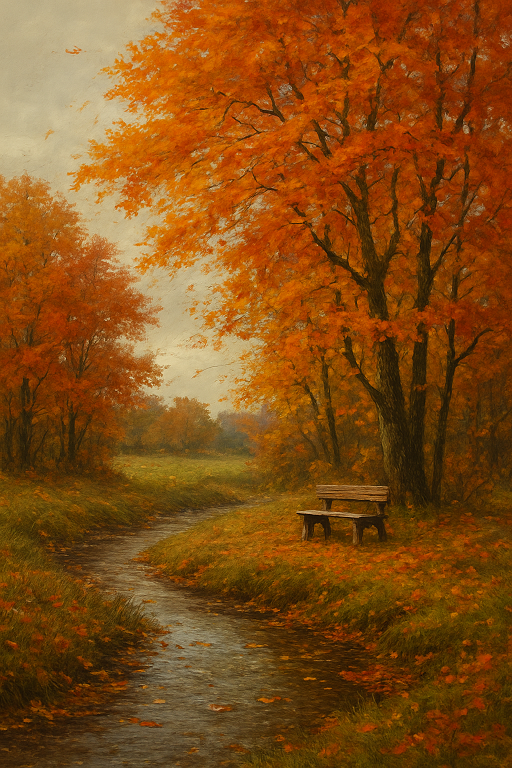
I never found Elysium, did you?
Behind my house there’s just a little patch
Of trees. An easement with a trickling stream
That fills with leaves of red and leaves of gold
This time of year. The wind is blowing hard
Against the branches, slowly stripping bare
The last remaining vestiges of life,
At least that life which stretches toward the sun.
Were we misled? Did we mislead ourselves?
The grass is getting long before the snow.
I think I’ll only cut it one more time.
Then, if there’s time, I’ll build a little bench
Beneath the patch of trees, beside the stream,
And watch it through the winter, from my house.
Scars (for Nora Sawyer)
Friday, September 7th, 2007Am I too late to note the past which passed
Without the notice of a poet’s pen?
What then would you or youth portray, unmasked
In these–these silent pictures now? What then
Will lace avail if what it frames is scarred?
Am I not clear? What words suffice to mark
The pale perfection of the page unmarred
By life? What skin escapes the Poet’s art?
In time the soundless scrawls of meaning fade.
Nepenthe left unquaffed evaporates.
In time the time when beauty was portrayed
As vanity like mist will dissipate.
Beneath your skin your pulse remains as strong
As when it first began its steady song.
On Seeing a Picture of Avril Lavigne That Brought to Mind Poe’s Lenore
Friday, September 7th, 2007Don’t stare too long; the shadows ’round her eyes
Absorb your soul. Don’t linger on her mouth,
The petals of a pout. Don’t sympathize
With milk; her skin is milk. Don’t be devout.
Look once and note forever how her hair
Asserts itself forever, like a stroke
Of paint that’s brushed by one who doesn’t care
If art is beauty or some cosmic joke.
Take all the time you need when she is gone
To press your head against some velvet thought–
Some thought divined, forever lingered on,
Rejected and embraced, escaped and caught.
Her youth is not the youth you meant to find
Upon the edges of your mortal mind.
Points of Light, Stretches of Dark
Tuesday, June 26th, 2007The stars are all too far away to touch.
What god would make a universe so vast?
What lesson to be learned? That life is much
too distant in the future or the past?
The closest stars seem just within my reach;
the closest stars are still too far away.
I only want to give a kiss to each;
I only want to find some way to stay.
But which of us has ever touched a star,
or even stretched to touch the loving sky?
We seal our little lights inside a jar,
and one by one the lights begin to die.
To god, the universe is just a spark;
to me, a point of light, a stretch of dark.
Harmonics of Desire
Monday, July 4th, 2005First Notes
He saw her profile by chance, a photograph framed by words, a post lingering longer than intended;
beneath her smile he sensed rhythm, pulse, a presence like music vibrating in anticipation;
nights afterward he returned, rereading, imagining melodies in the cadence of her sentences, typing messages and deleting them, sending them with trembling curiosity;
he envisioned subtle gestures, fingers brushing keys, humming along quietly, anticipation of presence and shared attention, a harmony forming in absent space that pulled him steadily forward.
Whispers in Rhythm
She answered with warmth, her words lilting, carrying cadences like quiet songs, playful and alive;
their messages became nightly rituals, fragments of days shared, laughter spilling like notes over invisible strings;
he felt his pulse tighten imagining her reading aloud, leaning over a laptop, fingers tracing lines, humming along, small gestures that marked attention and presence;
each message was a duet, a counterpoint to his thoughts, a melody of curiosity and longing threading through ordinary hours, quietly establishing intimacy through subtle domestic imagination.
Harmonic Curiosity
Fascination deepened as he imagined her voice, musical, soft, punctuated with laughter, the hum of breath and song in quiet rooms;
each message carried hidden melody, playful hints; he recognized a rhythm mirroring his own, a harmony of tastes and thought;
moral constraints pressed, yet desire pulsed like recurring motifs, hands reaching for invisible presence;
he pictured her leaning to read a line aloud, fingers brushing over pages, cups clutched between both hands, and felt small shivers of intimacy that preceded touch, delicate and electric, unspoken but vivid.
Invitation to Crescendo
Months passed until he typed the words he feared: an invitation to meet at her home while her husband was away;
her reply was cautious, curious, tentative but yes, and suddenly connection gained form;
he imagined stepping inside, warmth of her presence, music playing softly, the hum of familiar tunes guiding conversation and movement;
small gestures — hands over objects, cups passed, leaning close to read — created rhythm and intimacy before words;
anticipation vibrated like a finely tuned string, a duet awaiting performance in subtle, tactile harmony.
Prelude at the Door
He arrived when her husband was away, moving through streets alive with quiet anticipation;
she opened the door with a smile, soft melodies drifting from room, faint hums guiding interaction;
conversation began cautiously, loosening gradually; hands brushed over shared objects, shoulders touched lightly, laughter echoing in warm spaces;
the ordinary world outside vanished, leaving only them, bodies moving in familiar space, voices blending with music, proximity humming like a quiet chord, fragile and undeniable, weaving intimacy into rhythm and gesture.
Duet of Hands
Evenings passed in stolen hours, music always present: chords from guitar or piano, playlists reflecting mood, laughter layered atop;
touches were tentative, meaningful — leaning close to read, brushing hands over objects, sharing mugs, humming together;
each meeting deepened connection, rhythm of sound and subtle touch building intimacy, guilt and exhilaration entwined;
her voice hummed along to songs he had sent, he mirrored her, hands occasionally brushing, shoulders leaning near, a private choreography of attention and melody, creating harmony between bodies and presence.
Suspended Chord
Weeks turned into months, each meeting at her home charged with expectation;
he entered anticipating chord, gesture, hum, touch of hands or shoulder; music guided conversation, created pauses that lingered;
gestures became dialogue, fingers over sheet music, leaning in while she hummed a tune, eyes catching in shared silence;
desire intertwined with melody, guilt with beauty, creating tension and release like quiet symphony; boundaries tested, proximity measured yet intimate, rhythm orchestrating connection and teasing contact, a silent ballet beneath words and sound.
Resonant Consequence
She told him she had decided to carry his child, revelation falling like a resonant note;
months of shared music, subtle touch, leaning, humming, gestures had crystallized into life, tangible result of longing;
he held her hands, feeling pulse and rhythm, understanding how music underscored every secret hour, every brush of fingers, every leaned shoulder, every quiet ritual;
the child became a living chord connecting desire, consequence, intimacy, gestures, melody — a symphony unfolding beyond secret space, shaping presence and attention in subtle, enduring ways.
Dissonant Silence
As pregnancy advanced, intensity waned; stolen hours grew tentative; digital notes slowed; music remained a point of connection, sometimes hummed along, sometimes shared glance;
longing persisted, moral weight pressing; absence felt like silence in a missing chord; gestures once frequent became infrequent, each touch remembered;
rhythm shifted from crescendos to soft motifs, desire tempered by consequence; still connected through music and memory, proximity and intimacy became cautious, deliberate, delicate as a fading echo of hands, cups, hums, leaning and attention.
Echoes in Memory
Time and responsibility drew them apart; meetings rare, messages measured; music threaded memory, humming, playlists, echoes of gestures remembered;
he reflected on months spent in secret, hands lightly touching objects she had held, leaning close to hear her voice above melody;
she responded cautiously, acknowledging bond while maintaining distance; desire alone could not sustain connection, yet subtle intimacy — shared rhythms, gentle touches, humming, leaning, cups in hands — lingered, shaping memory, creating invisible bonds, threads of intimacy woven with sound and presence, haunting yet treasured.
Refrain of Freedom
Eventually, they divorced spouses, untangling lives; moral weight pressed, tempered by recognition that love had endured secretly;
Music became memory, guiding reflection; gestures once physical now lived in imagination, the brush of hands, leaning, shared hums, cups held between them, small coordinated movements remembered;
even as bonds dissolved and lives were reconstructed, memories of touch, proximity, song, and domestic intimacy persisted, shaping consciousness and feeling, hidden rhythm echoing across days, evidence of a bond both sensual and ephemeral.
Renewed Harmony
Time passed; each found new partners offering stability, trust, companionship; marriages celebrated, lives rebuilt; child remained connection, consequence of intimacy;
Music lingered in memory, playlists saved, tunes hummed in quiet reflection; gestures — leaning, sharing cups, humming together — persisted in recollection, shaping choices, perspectives, affection; intimacy persisted in memory, a hidden soundtrack threading everyday life, gestures and melodies remembered, proof that subtle physicality and emotional resonance endure even when love itself is transformed.
Harmonics of Time
Years later, casual encounters or reflections rekindled recognition; shared history, melody, intimacy lingered; gestures remembered — leaning, brushing fingers, humming, cups cradled — a duet of memory;
the child remained part of connection, yet music threaded past and present, shaping identity, evoking quiet longing; they glimpsed the power of subtle intimacy once lived in secret, intensity once hidden, gestures and music interwoven; they returned to lives enriched, altered, carrying echoes of duet, invisible yet deeply formative, shaping emotion, shaping reflection, shaping self.
Final Measure
In the end, love had neither permanence nor possession, yet music and subtle physicality marked its existence;
longing, secrecy, gestures, presence, melody, memory, and small domestic intimacies coexisted, leaving lives transformed, enriched, guided by rhythm and attention;
memory of shared sound, gestures, leaning, brushing, humming, holding cups lingered, proof that passion, once fully lived, leaves indelible marks;
even as paths diverged, the invisible duet of intimacy and melody persisted, shaping perception, shaping feeling, a testament to love’s power to move, transform, and endure quietly, invisibly, unforgettably.
Tell-tale
Wednesday, September 22nd, 2004Madmen know nothing. How then am I mad?
I know the mind of god, the mind of man
That madness is the heart of good and bad
And those who think they know this never can
That art and science merely serve to drape
Upon the naked form of what we know
We feel their chains and know we must escape
Or let them drag us down to hell below
Then every word we know is sounded near
And all the sounds, a sickly rhythm, make
A poem which the madmen only fear;’
Each beat a link which knowledge cannot break
And man is god when guilty of this art
It is the beating of his hideous heart
Love Made in Passion
Friday, May 28th, 2004I place my breathless mouth against your lips
I feel the warmth of love you have for me
You move against my motion with your hips
We hold each other tight as two can be
There is no way to justify my skin
The only way to celebrate is fast
I want to feel you come from deep within
The greatest that you've felt, you'll feel at last
And I will taste your cleanliness, your sweet
I love the loss of me inside of you
I love the feel of you I have to get
When color makes us wet, we're red and blue
Deserving you, I want to be your mate
I love your soul, without the altercation of debate.
Selfhood, Silence, and the Muse: Scott Ennis’s Contemporary Sonnet Practice
Thursday, December 30th, 1965The sonnet has long been regarded as one of the most enduring and elastic poetic forms in English literature. Since its introduction into England in the sixteenth century, it has provided poets with both constraint and freedom, a structure within which to explore love, mortality, faith, identity, and the shifting nature of language itself. From Petrarch’s original courtly meditations on unattainable desire, through Shakespeare’s dazzling blend of eroticism and irony, to the Romantic and Modernist revisions of Wordsworth, Keats, and Edna St. Vincent Millay, the sonnet has continually reinvented itself. Its survival rests on its paradox: the sonnet is a fixed form whose vitality lies in its capacity to adapt.
Scott Ennis, a contemporary American poet, takes up this form not as an antiquarian exercise but as an urgent medium for self-inquiry. His sonnet practice, as represented in his large body of work, reveals a poet at once reverent toward tradition and radically experimental. Ennis is acutely aware of the sonnet’s historical freight; his poems teem with references to its architecture—quatrains, couplets, iambs, and voltas—as well as to the canonical figures who defined it. Yet he turns this awareness inward, transforming the sonnet into a mirror for questions of identity, inspiration, and mortality. In doing so, he demonstrates how the sonnet in the twenty-first century continues to serve as a space for existential exploration.
This paper argues that Ennis’s sonnets enact a poetics of tension: between tradition and disruption, between the presence and absence of the muse, and between the aspiration toward immortality and the inevitability of mortality. Through close readings of key poems—including *“The Sonnet That I Am,” “Death of a Sonnet Writer,” “Muse Needed,” “This Sonnet Has No Name,” “Iamb that Iamb,”* and *“The Sonnet I’ve Become”*—I will show how Ennis transforms the sonnet into a site of self-reflexive inquiry. His work insists that the sonnet is not a relic but a living form capable of holding the contradictions of contemporary identity.
—
### Form and Identity: *The Sonnet That I Am*
Ennis’s sonnet *“The Sonnet That I Am”* serves as a manifesto for his approach to form. It begins:
> “I am my song, my pulse, my turn, my scheme
> If that constricts your mind then you should leave.”
The opening immediately collapses the boundary between poet and poem. The sonnet is not merely a form in which Ennis writes; it is the poet himself, his “song,” his “pulse,” his “turn,” his “scheme.” Each of these terms simultaneously denotes an aspect of poetic structure and of human vitality: “song” as lyric expression, “pulse” as rhythm and heartbeat, “turn” as both volta and existential shift, “scheme” as rhyme and as personal design. By layering technical vocabulary with bodily metaphors, Ennis fuses form with life, suggesting that to read the sonnet is to encounter the living self of the poet.
Yet the second line resists this intimacy: “If that constricts your mind then you should leave.” Unlike the sonneteers of the Renaissance, who sought to please or persuade their readers, Ennis defies them. His self-sonnetization is not an act of seduction but of defiance. If the reader cannot accept the poet’s fusion of self and form, they are invited to depart. This rejection destabilizes the sonnet’s traditional rhetorical function, which often relied on wooing an absent beloved or flattering a patron. Ennis instead asserts the primacy of his own voice over external approval.
Later in the poem, he situates his practice against the backdrop of literary tradition:
> “And yet, I’m not a temple on a hill
> I’ve seen too many temples come and go
> To make pretenses which I can’t fulfill
> Pretend I sound like somebody you know.”
Here the metaphor of the “temple” evokes the monuments of literary tradition, the canonical edifices erected by earlier poets. Yet Ennis refuses the role of temple-builder; he has seen “too many temples come and go” to believe in their permanence. Instead, he resists “pretenses” of timelessness or imitation, refusing to “sound like somebody you know.” This stance repositions the sonnet: not as an attempt to secure immortality, but as a momentary assertion of identity, fully aware of its impermanence. In this way, Ennis rewrites the sonnet’s Renaissance ambition to “eternalize” the beloved or the poet, instead embracing ephemerality as intrinsic to both life and art.
—
### Mortality and the Limits of Tradition: *Death of a Sonnet Writer*
If *“The Sonnet That I Am”* fuses life and form, *“Death of a Sonnet Writer”* stages their simultaneous dissolution. The poem opens with the ominous image of an hourglass:
> “He turned the fourteenth glass and said, ‘Begin.’
> and I had fourteen minutes left to live.”
The repetition of “fourteen”—the number of lines in a sonnet—becomes a memento mori device. Each aspect of the speaker’s life is quantified by “fourteen”: fourteen sins, fourteen loves, fourteen unread books, fourteen dreams. The relentless enumeration reduces life to a series of symmetrical yet insufficient fragments.
The final couplet brings this conceit to its inevitable conclusion:
> “This sonnet flowed like fourteen final breaths—
> the fourteenth line, the fourteenth grain, then death.”
Here the sonnet itself becomes coextensive with mortality. Unlike Shakespeare’s claim in Sonnet 18 that “so long lives this, and this gives life to thee,” Ennis offers no consolation of immortality. The sonnet does not outlive the poet; it ends with him, its final line coinciding with his final breath. The sonnet, once a promise of permanence, is reframed as a fragile human gesture, bound by time.
In this sense, *“Death of a Sonnet Writer”* can be read as a critique of the sonnet’s historical rhetoric of eternalization. It acknowledges the form’s capacity for symmetry and closure, but insists that closure must coincide with human finitude. The sonnet does not cheat death; it enacts it.
—
### The Muse: Presence, Absence, and Silence
Another recurring theme in Ennis’s sonnets is the role of the muse. In the Petrarchan tradition, the muse is a figure of inspiration, often an unattainable beloved whose beauty catalyzes poetry. Ennis, however, repeatedly questions this model, presenting the muse as unreliable, absent, or destructive.
In *“Muse Needed,”* he addresses the absence of companionship:
> “They call me single now: I have no wife
> I have a ringless finger, and my heart
> feels empty, but I want to share my life
> with you, because my poetry is part
> of who I am. I want you for my muse.”
Here the muse is not an abstract source of inspiration but a potential partner, a real presence whose intimacy would validate both life and art. The sonnet positions itself as a plea for companionship, conflating erotic and creative needs. Yet the conditionality of the address—“I want you for my muse”—underscores the transactional quality of inspiration. The muse is not a transcendent figure but an everyday necessity.
By contrast, *“This Sonnet Has No Name”* dramatizes the muse’s absence:
> “Such entropy of love and life exists
> in echoes of the muse who has withdrawn.
> And now a single memory persists
> which slips into the void: she’s gone; she’s gone.”
The repetition of “she’s gone” enacts the collapse of both love and inspiration. The muse’s withdrawal leaves only “entropy,” a scientific metaphor for disorder and decay. Where Petrarchan sonnets elevate the muse to divine status, Ennis portrays her departure as catastrophic, rendering not only love but also poetry itself void. Yet the act of writing the sonnet in her absence paradoxically affirms her continuing power: silence becomes the condition of lyric expression.
The paradox deepens in *“Silence”*:
> “She’s still the one who listens to me speak
> She’s still the one I turn to when I cry
> She gives me words like oxygen I need.”
Although absent, the muse remains present through silence. Inspiration here is not a gift of words but the granting of space in which the poet’s own words can emerge. Ennis thus redefines the muse not as an external force but as a relation to absence, an interlocutor who listens even in silence. In this sense, silence itself becomes a kind of lyric presence, enabling the poet to continue writing.
—
### The Self as Sonnet / Sonnet as Self
If the muse destabilizes the source of inspiration, Ennis’s identification of self with sonnet destabilizes the very boundary between life and art. *“The Sonnet I’ve Become”* offers perhaps the clearest articulation of this idea:
> “No more the man, but only what I write—
> Fourteen small lines to stand against the night.”
Here the poet is no longer a subject who writes sonnets; he is the sonnet itself. The reduction of identity to “fourteen small lines” emphasizes both the power and the limitation of art: the sonnet can “stand against the night,” but only briefly, and only within its constraint. Identity becomes inseparable from poetic form, suggesting that the self exists only insofar as it is written.
A similar play occurs in *“Iamb that Iamb”*:
> “To be the Word, I must admit I Am
> I Am the Word, Iamb, and Thou Art God.”
This witty conflation of theology and poetics fuses “I am” with “iamb,” the basic metrical foot of the sonnet. Identity here is metrical, theological, and linguistic all at once. By punning on “I Am” (the divine name in Judeo-Christian tradition) and “iamb” (the metrical pattern), Ennis equates poetic rhythm with existence itself. The poet’s being is indistinguishable from the form he inhabits.
Together, these sonnets illustrate Ennis’s radical self-sonnetization: his insistence that the self is not prior to poetry but constituted by it. Whereas traditional sonneteers wrote poems about themselves or their beloveds, Ennis collapses the distinction, becoming his own sonnet.
—
### Conclusion
Scott Ennis’s sonnets exemplify the paradoxical vitality of the sonnet form in contemporary poetry. His work engages deeply with tradition while persistently questioning it, treating the sonnet both as a historical structure and as a living embodiment of selfhood. Through poems like *“The Sonnet That I Am,” “Death of a Sonnet Writer,”* and *“The Sonnet I’ve Become,”* Ennis redefines the sonnet not as a monument to permanence but as a fleeting, fragile enactment of identity. Through his explorations of the muse’s presence and absence, he transforms silence itself into a condition of lyric expression. Through his playful self-identification with form, he collapses the boundaries between life and art, existence and rhythm.
In this way, Ennis demonstrates that the sonnet is not an exhausted relic but a form still capable of profound reinvention. By staging the tensions between tradition and disruption, inspiration and silence, immortality and mortality, his sonnets bring into focus the very contradictions of modern existence. Far from closing the book on the sonnet’s history, Ennis’s work suggests that the form remains an open field for self-inquiry in the twenty-first century.