A Sonnettics Sequence for Gerald Grove
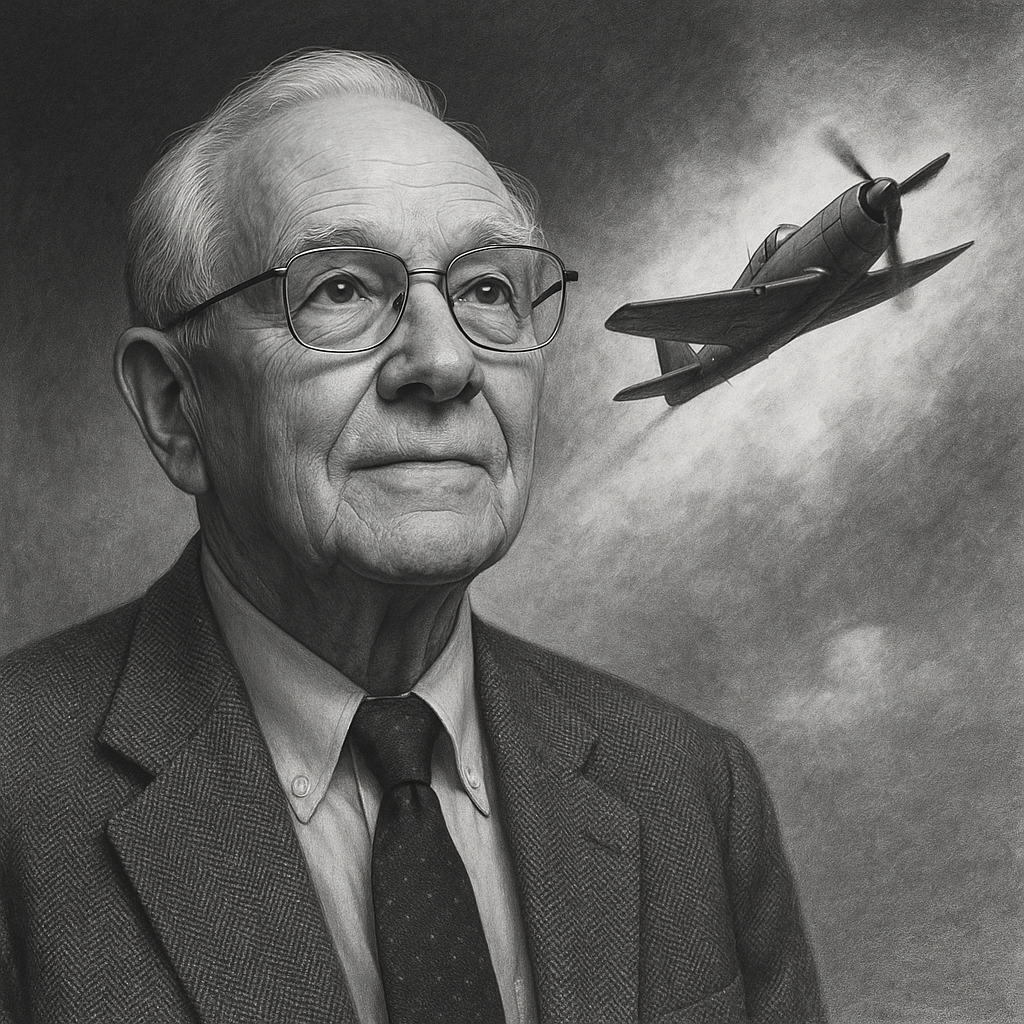
Cockpit Psalm

Above the reef, the sky became a book
Each cloud a page that opened into flame
The engine’s roar, a hymn that none forsook
Sustained the fragile weight of breath and name
He flew by feel; the sky became a scroll
Unfurled beneath the fighter’s silver prayer
No verse could hold the trembling of his soul
But silence took dictation from the air
A young man, he was older than the stars
He knew the cost of poetry and speed
Each loop above the harbor left its scars
Like lines revising what the heart must bleed
The sky was not a heaven, but a draft
He wrote his life in spirals, low and fast.

A View from Midway

The sea below was mythic, still, and vast
Too broad to hold the anger of a war
He flew through sunbreaks echoing the past
Where vapor trails outlived the planes they bore
In moments when the compass lost its pull
He’d think of Blake, of vision, wrath, and fire
The burning wheels, the angels terrible
The need to forge the world back into lyre
For fire, he’d trained; for fire, he wept alone
His wings were steel, but something still could break
A single stanza haunted him, unknown
Some song no tongue but memory could make
He banked and climbed. The island slipped away.
He carried death like dawn into the day.


Return to Earth

The war came home in ways the world can’t say
In quiet cups of coffee, books unshelved
The habit stayed in scanning break of day
As if the sky itself could be compelled
He walked with calm. He welded on the side
Acetylene would hiss like distant shells
But when he taught, his eyes were opened wide
And flights of thought rang out like chapel bells
He read aloud, Romantics like a rite
His voice a climb through meter, breath, and blaze
And when he traced a metaphor in flight
We saw the pilot pierce the cloud of days
He found in Keats a brotherhood of flame
Both knew how brief the arc before the name

Shelley’s Lift

He said that Shelley never quite came back
He died mid-sentence, dashed against the sea
We watched him draw a vortex on the black
Chalkboard like smoke from some divine debris
The classroom sighed. He paced it like a deck
A flier’s gait, the gait of those who flew
By trusting sky with muscle, nerve, and neck
And yet he spoke of beauty, and of rue
Romanticism, he smiled, is a dare
To soar without a net, to write in flame
We never knew if he was still up there
Or walking through our world with borrowed name
He told us Shelley’s wreck was also birth
The fall, the fire, the song that scorched the earth


Annotating Byron

Imagine him, that lord of reckless fire
The rebel-verse of thunder, wrath, and pride
He lived like gunpowder inside a lyre
And left behind a musket he could ride
So spoke the man who’d once outpaced a bomb
Who dove through tracer rain in search of light
Yet here he stood, exacting, fierce, and calm
Explaining how a rhyme concealed a fight
Byron, he grinned, was every pilot’s ghost
Too brave to land, too vain to turn around
He soared until he burned out on the coast
But damn, what poetry before he drowned!
He said this like he knew the poet’s bones.
He said this like he heard Lord Byron’s moans.

For the Ghost Crew

He never boasted. War was not his song
But once, in spring, he shared a tale at dusk
Of men who flew yet didn’t come along
Their laughter gone like engines in the husk
He looked out toward the Wasatch as he spoke
His hands unclenched. The past passed through his frame
The air went still. A birch tree shed its cloak
His voice came low, no anger, and no blame
They read no Keats, nor Shelley that I knew
But some could quote their mother’s Sunday grace
And when they died, the heavens let them through
No epitaph, just sky to take their place
He closed the book. He sat. The room was bare
But every desk had wings. And every chair.


Labors of the Forge

On weekends, he would work with fire and steel
His shop smelled sharp, of oil, of iron, of heat
The helmet flashed as metal learned to feel
He shaped a blade and set it near his seat
The poet-warrior never said too much
But stories shimmered from his hands and scars
He’d offer coffee, never wine or such
And polish words like hinges off of stars
To weld, he said, was just another form
Of writing, heat and fusion, stress and spark
A sonnet’s arch, a plane’s deflection norm
Each found its shape by dancing with the dark
His mask went up. His wrinkled face was kind
With flame he forged whatever might remind.

A Question After Class

Did you ever feel afraid up there?
I asked. He paused. The room was going gray
He smiled as if my question hung in air
Like frost that never quite gets burned away.
Not fear, exactly. Focus. Then release.
The mind goes tight, the world turns thin and wide.
There’s nowhere left to hope for war or peace
Just one more loop to spiral, then to glide.
He stood, and pointed skyward, then withdrew.
I flew by faith, and later taught by doubt.
Romantics chase the infinite, and you
Perhaps, will learn what that pursuit’s about
He turned. I never asked again, nor tried
But oh, I heard the answer when he died.


On Reading Wordsworth in Late November

He kept a copy folded in his coat
A Wordsworth page, dog-eared and stained with sun
The world is too much with us, he would quote
And close his eyes as if the war’d begun
But no, it was November, and the trees
Were bare as fuselages long at rest
He taught us how to find the lines in leaves
The grief in dawn, the oaths beneath the chest
His voice was calm, like lakes before the freeze
He read as though the page could still forgive
Trauma and daffodils, he said, are keys
Both teach us how the broken learn to live
And when he sighed, we knew the loss was near.
But still he read. And still we strained to hear.

After the Department Meeting

The others talked of schedules, funds, and form
He simply smiled, and drank his quiet tea
The poems waited—not for them, but warm
Inside the satchel, waiting to break free
He left the room when quarrels found their pitch
Not weak, but wise, like veterans who will choose
To save their rage for truth, not petty itch
For Blake, not memos penned in chapel pews
That night, he stayed behind and marked a text
With purposed ink (regardless what’s been said)
We passed and saw his margin notes, perplexed
To die with fire, means first to have been read.
That ink, those words, they lived beyond the day.
They taught us how to vanish, not decay.


Grading Finals in the Snow

The snow was thick outside his office door
He lit a lamp, and hummed a little hymn
His pen moved slow, but always found the core
The grace, the spark, the promise in the dim
Some students passed. A few had dropped the class
But all of them were carried in his scroll
He saw beyond the grammar’s brittle glass
And marked, instead, the tremble of the soul
He whispered lines from Keats, much more than one
The wind knocked twice, then stopped. The poet smiled
His hands were old, but everything he’d done
Made time itself seem briefly reconciled
When snow began to cover up the quad
He wrote one final word: Perhaps. Then God

A Student Recalls

His name was Grove. He taught the sky and sea
I never knew a man more near to myth
He walked like flight, and spoke with clarity
Each word a dial the storm brought forth, forthwith
He taught me Shelley, yes, but also grace
The art of falling well, and writing clear
He met my words in calm, a noble place
He said: The bravest thing is staying near
I kept his notes. I kept his voice in dreams
And now, when dusk descends, I sometimes write
His eyes still read my words, or so it seems
As if my songs might pass into his light
He never flew again. But still I swear
I’ve seen his soul come banking through the air.


The Memorial

A flag. A poem. A polished helmet’s shell
The bell rang twice, and silence held its tune
A veteran spoke of fire and Keats as well
How bombs and odes once shared the same high noon
The podium bore petals and a quote
Beauty is truth, truth beauty...read in hush.
A former student read the lines he wrote
And no one dared to check their watch or blush
He died with grace, not fame. He left no stain
Just perfect papers, metalwork, and lore
A man who looped through grief, and back again
To teach what no one ever taught before
His story ends the way a sonnet should
With music folded in, and understood.

Clear for Climb

And now he flies beyond my metaphors
No dive, no blaze, no elegy can bind
His breath is wind. His feet have left the floors
Of war and class and age and wounded mind
But still he climbs, on ink, on arcs of thought
On every line he underlined for grace
And we who heard the poems that he taught
Still feel him press the air, still trace his trace
Romantic, combat veteran, welder-sage
He built his life in fuselage and form
The sonnet was his runway. And the page
Became the sky through each revising storm
Good night, Professor Grove. Your wings extend
The climb is clear. Your flight will never end.